

Venturing Beyond the Mainstream Narrative
Reclaiming Human Agency Amidst Mainframe Enchantment

Zurich, Switzerland | March 8, 2026
When I started this publication in 2023, I named it The Human Advantage and my first ever post invited you on a journey to explore the mystery, magic, and joy of being human and alive. I called it “an invitation to listen with our hearts, think on our feet, speak truth to bullshit, and act sacred, not scared.”
As some of you know, recently I encountered the World Economic Forum–McKinsey Health report on the Brain Economy and the Brain Skills they propose as the foundation of The Human Advantage. My initial reaction was utter shock: our humanness reduced to the brain.
I shared some of that reaction in my last post but I also withheld some of it as I felt that there is more than meets the eye. Then I followed my own advice to listen with my heart, think on my feet, speak truth to bullshit, and act sacred, not scared. And as I did that, I felt a milestone reached, maybe even a reason to celebrate.
Here’s why.
First, with the WEF–McKinsey report, The Human Advantage as a concept entered the mainstream. Two institutions many view as thought leaders and trendsetters have centered our attention on the idea that humans have an advantage to the machines. Great! When the mainstream are catching up with the outliers, that’s a good sign.
Second, they recognize the need to shape education, organizations, and institutions around The Human Advantage. So far, so good. Education needs to be transformed, and so do organizations and institutions. Agreed!
Third, as I searched online, I noticed a lot of people and organizations recently adopting the phrase The Human Advantage. Great again! If it takes the WEF & McKinsey to start speaking about it, fine. Whatever it takes.
Where I depart from the WEF & McKinsey is on what constitutes The Human Advantage. That is where my first reaction was, and truth be told, I am still trying to digest how they defined it.
But then something dawned on me and I started laughing at my own naivety. Let me draw a parallel to make my point.
There was a time, not so long ago, when we started to differentiate between management and leadership. Today, many years later, we still do not have an unified understanding of what great leadership is. So, how could we immediately agree on what The Human Advantage is?
And there is even more to that. My own exploration of leadership spans lived experiences, formal and informal education, and academic research. Early on, I looked up to sources like McKinsey, among others, only to realize that they were limiting and missing the point altogether.
For example, ten years ago, I wrote in my old blog an article titled “Why I disagree with McKinsey Quarterly’s Article on ‘Decoding Leadership.’” In that article, McKinsey had claimed four out of twenty leadership behaviors to be the most important behaviors leaders need to exhibit. Those four were ‘solving problems effectively’, ‘strong results orientation’, ‘seeking different perspectives’, and ‘supporting others’.
To anyone who has led, or has been led, saying that these four behaviors capture what makes a good leader is ridiculous. Yes, these are surely important things but saying that they decode leadership is shortsighted. Even high school books define it better.
The research itself they did at the time wasn’t inherently wrong. The problem was the scope: the twenty behaviors were chosen largely from a performance driven perspective and skewed toward management competencies. If you know Richard Barrett‘s model of leadership and organizational consciousness, that focus sits at the third level out of seven levels of consciousness. That level is largely focused on the mental aspects leaving behind the physical, emotional and spiritual ones.
When McKinsey came out with that research, concepts like emotional intelligence, spiritual intelligence, and systems intelligence were pretty mainstream already but obviously not mainstream enough for them. Such concepts, among others, bring together the rest of the levels of consciousnesses into what Richard Barrett calls a full spectrum consciousness.
Ten years later, WEF & McKinsey tie The Human Advantage to that third level again, and how come I’m surprised? Ten years are a pretty short time in human evolution. Where it gets confusing is that McKinsey’s daughter company Aberkyn has proven very knowledgeable on connecting leadership to all aspects of consciousness. But that is probably a whole other article.
The bottom line
We live in an age shaped by AI, automation, and globalization, where humans are increasingly displaced by capital-intensive systems and data-driven decision-making. As technology blurs real and artificial, organizations face harder competition, ethical dilemmas, and challenges sustaining wellbeing, differentiation, and long-term advantage. Individuals confront questions about careers, purpose, and livelihood. Many of us yearn for a clearer understanding of uniquely human capacities like intuition, creativity, agency, and wisdom, as well as deeper understanding of concepts like consciousness, values, purpose, and integrity.
Said in a different way, as we probe AI’s limits, we’re forced to better understand our own humanness:
Parents must nurture skills in children that machines cannot replicate, ensuring future employability and meaningful lives.
Educators must redesign curricula to teach what machines cannot do, as well as teach how to harness AI and other machines as tools.
Business leaders need clarity where real competitiveness, differentiation and value-creation will happen when every organization can access AI.
Governments must plan for societies where many traditional jobs disappear.
Individuals must move beyond fearing AI and cultivate the uniquely human qualities that will matter most.
No matter how the mainstream defines it, The Human Advantage is real, it’s a sacred gift we are granted at birth. Understanding what constitutes it is a pretty pressing issue. However, expecting answers to our most pressing questions to come from the frontrunners of the current system is naive. They will come from outliers who can see beyond the current Matrix.
The good news is that The Human Advantage has been put on the map. As debates over leadership or consciousness never cease, the discussion of how humans outperform AI and other machines will be refined, contested, and sometimes desecrated. Therefore, the real work begins now.
Our future depends on where we place our attention. Will we follow status-quo frontrunners, or will we embrace what many already recognize:
Humanness cannot be reduced to the brain alone. Many people are working in this field but I want to especially bring your attention to Rupert Sheldrake- a PhD, biologist, researcher and author best known for his hypothesis of morphic resonance. He proposes that the brain is indeed a very important part of our bodies but not as we imagine it. He describes it is a receiver, tuner, and transmitter of consciousness and not its container or creator.
Alongside the brain, we must honor the roles of the heart, gut, and the rest of our body, as well as the soul. For example, Gregg Braden (a scientist internationally renowned as a pioneer in bridging science, spirituality and the real world) describes the heart as an “intelligent system” with its own “little brain,” acting as an antenna that senses and processes information independently of the cranial brain. Combined with the enteric nervous system (“gut intuition”), this yields a more holistic, resilient, and intuitive way of living.
Concepts like soul, spirit, consciousness, wisdom, agency, and creativity are still somewhat elusive to science but that should not make them irrelevant to understanding our humanness. Elon Musk put it starkly: “The bottom line is, I think we need to assume that life and consciousness is extremely rare and it might only be us... and if that’s the case, then we need to do everything possible to ensure that the light of consciousness is not extinguished.” I would add to his words that if it is not only us, it is just as important.
If we continue to shrink humanity to a purely cerebral model, we miss the full picture. Today, I choose to see this gap as an opportunity, not a setback.
I’m glad The Human Advantage is now visible, but that also creates a sense of urgency. We need to become aware that the frontrunners of the current system don’t own or embody it, just as they do not define leadership.
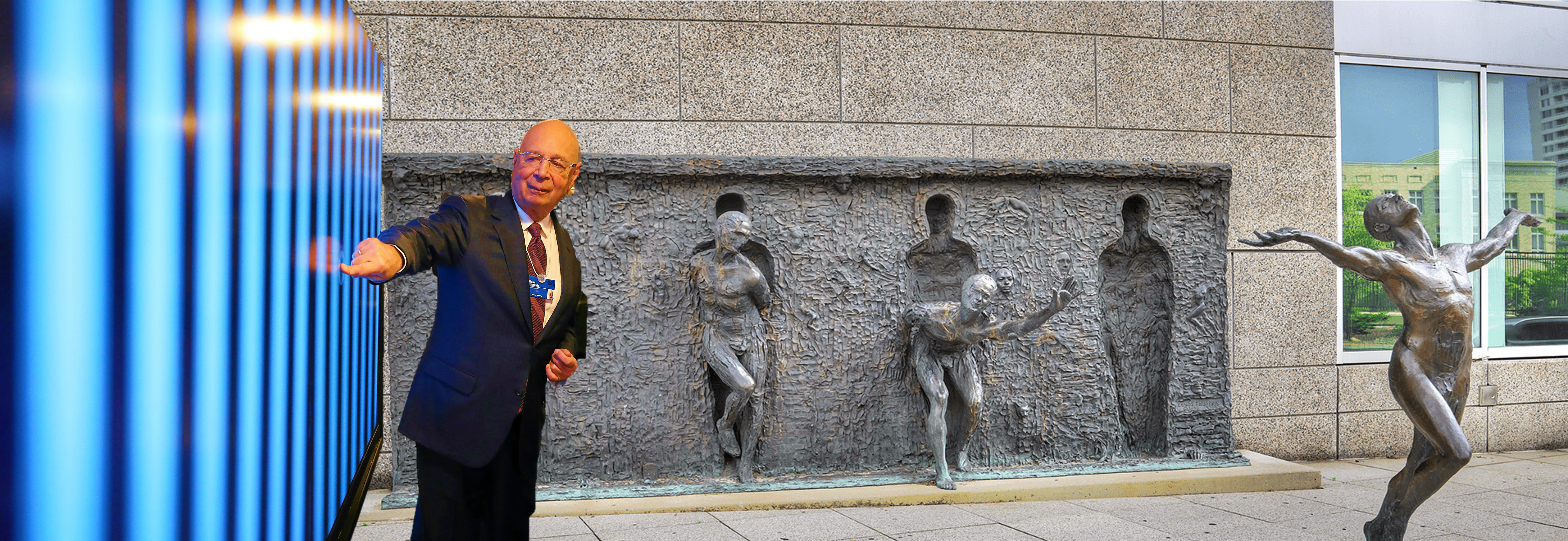
In the collage I used, I referenced Zenos Frudakis’s Freedom Monument, which according to the author shows four stages of freedom:
It begins with a mummy-like, captive figure, tightly bound to its background. (Sorry, my collage doesn’t show it; it’s covered by you know who.)
In the second panel, the figure begins to stir and struggle for release.
In the third panel, he has torn himself away from the wall that once held him captive and is stepping forward, reaching for freedom.
In the final frame, the figure is entirely free, victorious, arms outstretched, completely removed from the wall and the grave-like space he has left behind.
And that brings us to the heart of what matters: where we direct our attention shapes where the system will go. Will we squeeze ourselves into The Human Advantage mold they’re handing us? Or will we break free?
This is the essence of one of our most vital human traits: true human agency and the ability to act out of a deep place of knowing what’s right and what’s wrong. And while we’re still contemplating what human agency really means, the tech world is already rolling out Agentic AI. In the words of their creators, Agentic AI doesn’t just respond, it acts proactively and independently. Others claim that they have detected signs of consciousness in AI.
It’s a fact that humanity is still stuggling to explain what consciousness or agency are. So, anything we get presented as agentic or as consciousness is limited to the level of consciousness out of which the people presenting operate.
What I know for sure is that agency, consciousness, creation, among others, are clear aspects of our humanness and The Real Human Advantage. I also know that the longer we hesitate what it truly means to be human, the longer we delay reclaiming and deepening our own agency, the more potentially overshadowing these artificial agents may become.
Beautiful comment! You should have written Warning>>> You might understand your own role and you might be inspired to do something different....
I especially like this part: "History is, once again, about to repeat itself. If we have learned anything from the past, it should probably be this: when we forget that we are all sacred, we doom ourselves to repeat the power game: control over another = exploitation."
And also, " The new hero of the story is not in any one 'Neo', it is in all of us together, not the 'hive mind', but rather those who have discernment, who have had their boots-on-the-ground and have been learning about reality in real time -- risking, failing, doing, creating, connecting and discerning."
And "They do not deserve power, they deserve healing." ...
And much more... It's full of gems. Thank you, Mia!
Ah, and lastly, I experienced the same huge sigh of relief and a sense of peace...
"[E]xpecting answers to our most pressing questions to come from the frontrunners of the current system is naive. They will come from outliers who can see beyond the current Matrix."
Exactly.